


Pool Removal in Tight Backyards – What Homeowners in Maryland, Northern VA & Washington, DC Should Know
Updated: Mar 12

When most in-ground swimming pools were built, no one imagined a day would come when that pool would be demolished and filled in.
Over the years, we’ve seen pools installed in some of the tightest backyards throughout Maryland, Northern Virginia, and Washington, DC. More than once, we’ve walked onto a property and thought, “Someone really wanted a pool.” And often the question becomes — how did they even get this pool back here? In many cases, the pool was installed before neighboring homes, additions, fences, or landscaping were added, when access was much easier.
Today, those same properties can present serious logistical challenges during pool demolition.
Decades of Life Built Around a Swimming Pool
It’s not uncommon for 20, 30, or even 40 years of “life” to develop around a swimming pool, including:
Mature trees
Patios and retaining walls
Sheds and fences
Extensive landscaping
Clothes lines
Koi ponds
Overhead utility lines
Memorial trees
Even family pet burial areas
For long-time homeowners in areas like Maryland, Virginia, and Washington, DC, these features often carry deep personal value. Naturally, many clients want us to preserve as much as possible during the pool removal process.
Newer homeowners are sometimes more open to removing structures within the equipment access path. Either way, every pool demolition project requires careful planning and realistic expectations.
“Compact Equipment” Still Has a Footprint
Yes, professional pool removal contractors use compact equipment whenever possible. That’s standard practice in residential demolition.
However, “compact” does not mean impact-free.
Even smaller skid steer loaders and mini excavators carry significant weight. There are limits to how small equipment can be while still safely and efficiently:
Breaking up gunite or concrete pool shells
Removing steel reinforcement
Extracting coping and decking
Backfilling and compacting soil properly
In many neighborhoods throughout Montgomery County, MD, Fairfax County, VA, and surrounding DMV communities, access is tight and staging space is limited. That requires experience, strategy, and sometimes tough decisions.
Tight Access & Constricting Yards: A Real Example in Chevy Chase
We recently evaluated a pool removal project in Chevy Chase, Maryland. There was technically enough clearance for a skid steer loader to reach the backyard — but the machine would have needed to travel extremely close to the home’s foundation wall.
Because compact equipment is still heavy, repeated travel near a block foundation can create stress that may not show visible damage immediately. Many homes in the DMV area have finished basements, meaning foundation walls aren’t visible for inspection.
In this case, we had to recommend removing a large evergreen tree to create a safer access path away from the foundation.
It wasn’t an easy recommendation. But when weighing the structural integrity of a home against a tree that may eventually require removal anyway, protecting the house must come first.
When Neighbor Access Becomes Necessary
In rare situations, accessing a backyard pool requires temporary use of a small portion of an adjoining property.
We only proceed with written and signed permission from:
The homeowner
The adjoining property owner
Our company
All parties sign a formal access agreement before work begins. If you own a restrictive or landlocked property and are considering swimming pool demolition, it’s wise to start communicating with neighbors early in the process.
Case Study: Pool Demolition in Falls Church

At a recent pool demo in Falls Church, Virginia, the only backyard access point was blocked by an aging shed directly in the equipment path.
he homeowner was aware of the issue before requesting a quote. The shed was structurally deteriorated and no longer functional, so we permanently removed it to allow safe equipment access to the swimming pool.

Sometimes removing obstacles is the only practical way to complete a proper in-ground pool removal.
Complex Access in Baltimore County
We were recently called to complete a vinyl-lined pool removal in Baltimore County after another contractor abandoned the project.
Both side yards were extremely narrow with structural obstructions. The neighboring property owner declined access. That left only one viable entry point: through the carport.
The carport had a low ceiling, and the rear wall — which existed solely because of the pool’s layout — had to be permanently removed. Since the pool was being filled in and eliminated, that wall was no longer necessary.
Every property presents unique challenges. Experience in residential demolition makes all the difference.
Soil Staging, Driveways & Local Regulations
Homeowners often request that fill dirt be staged in the street instead of on the driveway.
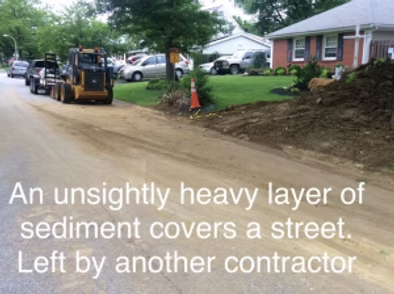
However, most counties and municipalities throughout Maryland and Northern Virginia strictly prohibit dumping soil in public roadways without authorization.
Improper staging can result in:
Stop work orders
Code violations
Significant fines
If staging in the street is the only feasible option, we coordinate carefully and ensure that no soil or sediment remains at the end of each workday, complying fully with local regulations.
Realistic Expectations for Swimming Pool Removal in the DMV Area
When pools were originally installed decades ago, future demolition was rarely considered. In some cases, limited access means certain sacrifices may be necessary to properly remove and backfill the pool:
A tree may need to be removed
A retaining wall or steps may need modification
An outdoor A/C unit may require temporary relocation
A shed or fence may need dismantling
We always aim to minimize disruption and protect both your property and adjoining properties. But honesty and preparation are essential when dealing with tight access pool demolition projects.
It’s Not About Speed — It’s About Doing It Right
Professional swimming pool removal in Maryland, Northern Virginia, and Washington, DC isn’t about rushing the job or simply closing a contract.
It’s about:
Protecting structural integrity
Managing access responsibly
Complying with local regulations
Respecting neighbors
Delivering a stress-free experience
Every property is different. Every access path is unique. And careful planning makes all the difference.
If you’re considering in-ground pool demolition or fill-in services in the DMV area, understanding the realities of tight access and long-established landscaping is the first step toward a successful project.


